
Crafting Your Personal Brand

Tips, tricks, and other guidance on developing your voice, tone, and style for your own personal brand! This article will provide you with a step-by-step roadmap to crafting your personal brand.
In this article:
- What is personal branding?
- Personal Branding Roadmap
- Stop 1: Self-Reflection & Discovery
- Stop 2: Assemble Your Building Blocks
- Stop 3: Developing Style & Tone
- Stop 4: Create & Curate Content
- Stop 5: Build Relationships
- Stop 6: Improve Your Skills
- Stop 7: Seek Feedback
- Stop 8: Consistency & Maintenance
What is Personal Branding?

Personal Brand, noun — a consciously created brand identity designed to represent oneself or larger entity in an attempt to create a lasting impression on others, often used by individuals to market their skills or establish themselves as an authority figure on their subject matter.
Personal branding is:
- both online and offline
- intentional
- memorable
- authentic
- effective
- fairly consistent
- aligned with your personal goals and values
You may be asking yourself why should you establish a personal brand — there are LOTS of reasons you might want to! Aside from it simply being fun to do, it also:
- Helps to establish your ethos and manage your reputation
- Opens up professional opportunities for you and help you to network
- Showcases your ability to communicate with others
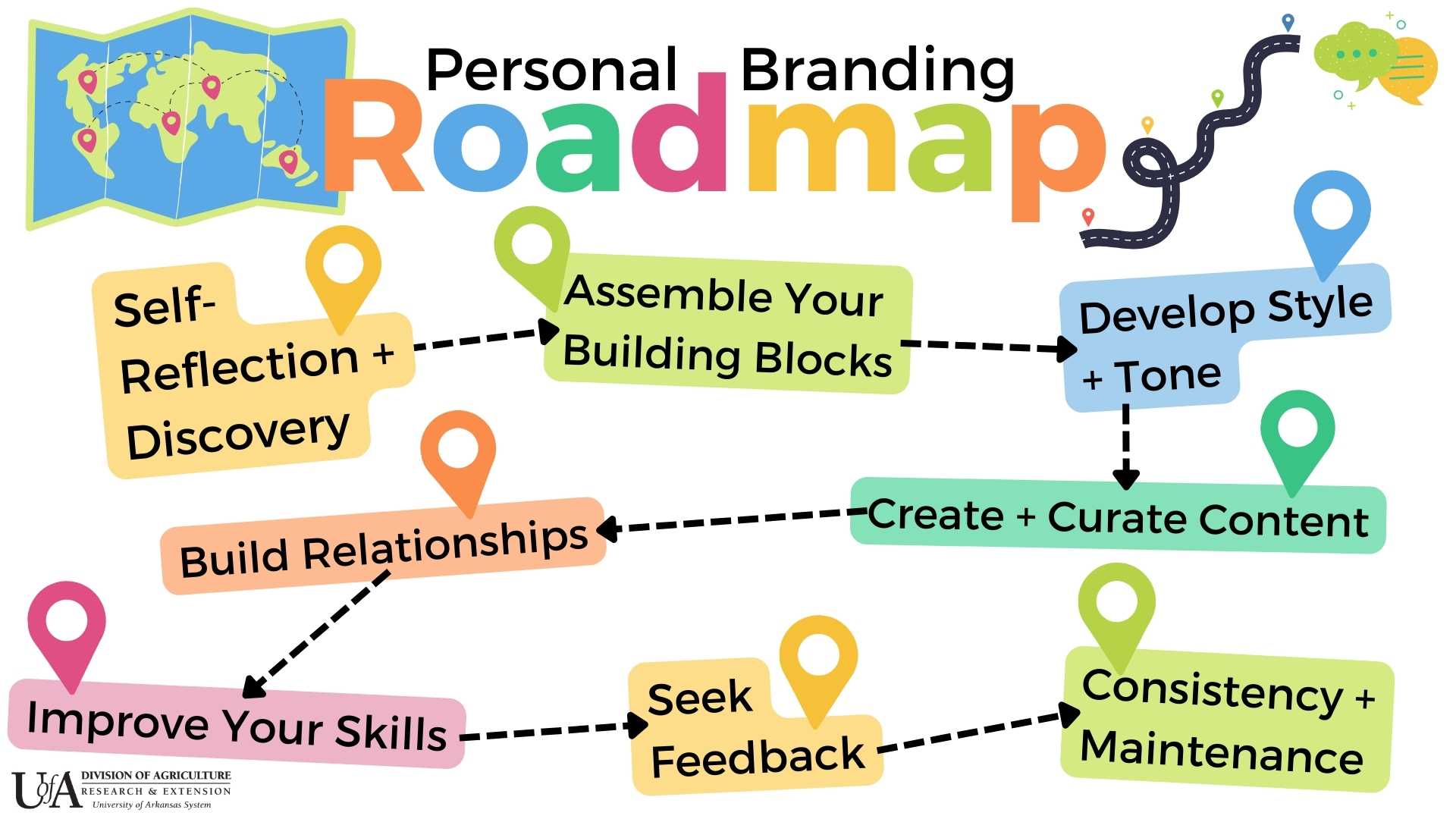
Are you ready to start your personal branding adventure?
Each stop on this map will give you an opportunity to explore a different aspect of personal branding, all of which are important. While it may seem like a lot of information or a lot of work, keep in mind that:
- personal branding is a life-long process, and
- your personal brand will evolve and grow as you do, so don't stress out about "not being there yet."
Take each leg of the journey as it comes, and pace yourself! 😊
Stop 1: Self-Reflection & Discovery
 In this phase, we are taking a step back and taking a look at our character.
"Character" is the qualities and behaviors that shape a person's identity and influence the way they interact in society.
Brainstorming Questions
While you are working through figuring out your personal brand, know that there are a number of Brainstorm templates available on Canva you can use to start working through your thoughts. You can use tools such as Pinterest to help work through some ideas for your personal brand as well.
 Some questions you can ask yourself to help with this exercise include:
- Who are you to the world?
- What are your strengths and weaknesses?
- What do you value?
- What are your favorite things?
- What are you passionate about?
- What do you believe in?
- What have you achieved?
- What do you stand for?
- If my life were a color scheme, which would it be?
- If my life were a genre of music, which genre would best?
- Which brand/person/influencer do I most aspire to be like?
- Which things/events/people/etc. in my life have shaped my character the most?
- If my life were a novel, what would the cover of the book look like?
- If my portfolio could only showcase 3 things, which things would I choose?
- If I could describe my personal brand in 1 word, phrase, or sentence, what would it be?
- How would I describe my character to someone who's never met me?
- What do I hope to one day be known for?
- During my lifetime, I would like to:
- Travel to which 3 places?
- Adopt which 3 hobbies?
- Master which 3 skills?
- Own which 3 material things?
- Learn which 3 things?
- Contribute to which 3 causes?
- Have which 3 experiences?
- Achieve which 3 goals?
Download a printable version of these personal branding journal prompts!
Auditing Your Personal Brand
Another exercise we can do to help us understand our personal brand better is to take a look at what is already there. This includes assessing your social media presence, your digital footprint, AND your physical, mental, and emotional character as well!
Here are some tips for a healthy digital footprint:
- Google yourself to see what's out there.
- Set up Google Alerts for your name, email address, and other related phrases to receive regular emails about new content published on the Internet.
- Scrutinize your public social media accounts.
- Optimize your LinkedIn profile.
- Check out your privacy settings on all your social media accounts.
- Practice good digital etiquette — NO bullying!
- Monitor your tags and mentions on social media.
- Ask yourself, "Is the digital presence I have a good representation of me?"
Stop 2: Assemble Your Building Blocks
Once you've done some self-reflection, you can begin to build the foundation for your personal brand. To build your online presence, consider making any of the following:
- Personal website
- Digital portfolio
- A blog
- Social media pages
- A newsletter
- A podcast
Building a Website
 If you are wanting to build a website for personal use, you can try an easy, free
option, such as Wix, WordPress, GoogleSites, or other user-friendly option.
If you are wanting to build a website for personal use, you can try an easy, free
option, such as Wix, WordPress, GoogleSites, or other user-friendly option.
If you are wanting a web section on the UAEX site or other website, please reach out to webhelp@uada.edu. Find additional resources at Communications for UADA.
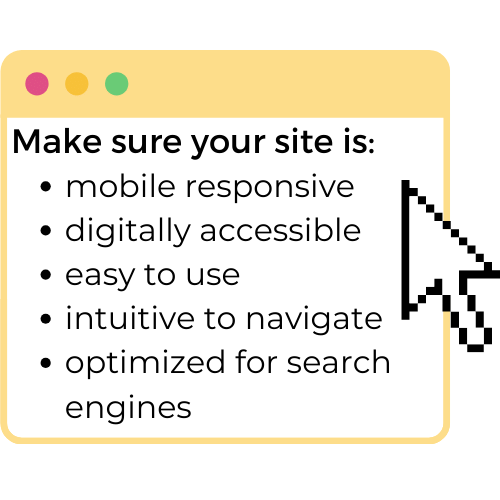
If you are building a website for personal use OR building website content for your work at UADA, be sure to keep the following in mind:
- Mobile-Friendly: Check how your web content looks on a mobile device. Building any content on the web to mobile-friendly is a lot easier if you build it in at the beginning instead of trying to retroactively fix it later.
- Digital Accessibility: Ensure that any content you make is digitally accessible. This includes adding alt text, captioning videos, and considering color contrast. Learn more about digital accessibility.
- User-Friendly: Consider who will be using your content, and build it so it is a breeze for your audience to use! If there are barriers standing in the way of your content, your audience is more likely to give up instead of engage.
- Intuitive: Consider how intuitive your content is to navigate. Try to make your content effortless for your users to find what it is they are looking for.
- SEO Optimization: Make sure you are optimizing your content for search engines like Google, Bing, and Yahoo! to find your content and show it on the first, second, or thirds pages of search results.
Don't know what to include on your site? Consider adding a:
- Professional portfolio
- Media appearances
- Testimonials
- Resume and/or CV
- Awards and achievements
- Bio statement
- Professional photo
- "About Me" section
- Contact info
- Social accounts
- A blog
- If you sell things, you may wish to also include a shop or gallery of what you sell
Social Media Tips
You may be thinking to yourself that this is all a bit overwhelming, and it can certainly get overwhelming quick! Which is why it is important to pace yourself and not over-do it. Something very important to remember is — you DO NOT have to be on every platform!
Pick 1 or 2 platforms at first and get your feet wet, and then if you want to add another, you can can add more later.
You will want to pick your platform based on who you want to talk to and the kind of content you want to make. If you only want to create short-form videos, consider YouTube Shorts, Instagram Reels, and TikTok, but if you want to mostly share photos and/or graphics, Facebook and Instagram may be better for you.
When you are creating content, always remember to watch what you post, as it can always come back to haunt you if you are not careful. Avoid being ugly to people, bullying, being belligerent, or sharing anything you wouldn't want the whole world to know or see.
Also keep in mind that if you are ever scrolling on social media and you see content that is unwelcome or someone is harassing you, you can report the content or social media account, and if the platform deems the offense unacceptable, they will remove the content or suspend the account. The report button is your friend!
For more info on how to work with social media for official UADA accounts, visit uada.edu/social-media.
Resource: Social Media Guidelines and Etiquette for UADA Employees
Choosing a Good Profile Picture
 Remember, your profile picture is often people's first impression of you, your page,
and your content, so be sure to choose a good one! When deciding which profile picture
you would like to use to represent you on social media, consider the following:
Remember, your profile picture is often people's first impression of you, your page,
and your content, so be sure to choose a good one! When deciding which profile picture
you would like to use to represent you on social media, consider the following:
- Keep it professional: Professional doesn't necessarily mean it has to be a headshot taken by a professional photographer. Just be sure to avoid using questionable photos that include explicit content. You can even use a selfie if you'd like!
- Pay attention to how it crops: Sometimes a profile picture gets cropped, and it cuts off pieces of the image you were hoping to keep, and this may cause the photo to be oddly centered or missing important information. If the photo doesn't crop well when you set it as your profile picture, you may wish to choose another, or you can sometimes crop or edit it so the photo crops differently.
- Choose a clear photo with good lighting: When you are taking your photos, make sure your camera lens is clean and the lighting is good so your image is high-quality.
- Make sure your photo shows your face: If your account is for you personally, you will want to make sure people can see your face. This will allow people to connect easier with and it can help build trust and ethos.
- Avoid group photos: Group photos make it difficult to determine who you are in the photo, so you will want to make sure to pic you pick is just of Y-O-U!
- Select a recent photo and update it periodically.
- Let your personality shine through: If your photo looks like everyone else's, it can be a challenge to stand out or set yourself apart. There are infinitely many ways to let your personality come through, so experiment and have fun! It is important that your photo, as well as all of your digital presence, is authentic to you.
- Ask yourself, "Does my profile picture match my personal brand?": Make sure that your profile pic matches the character you are developing on your social media pages.

Stop 3: Develop Style & Tone
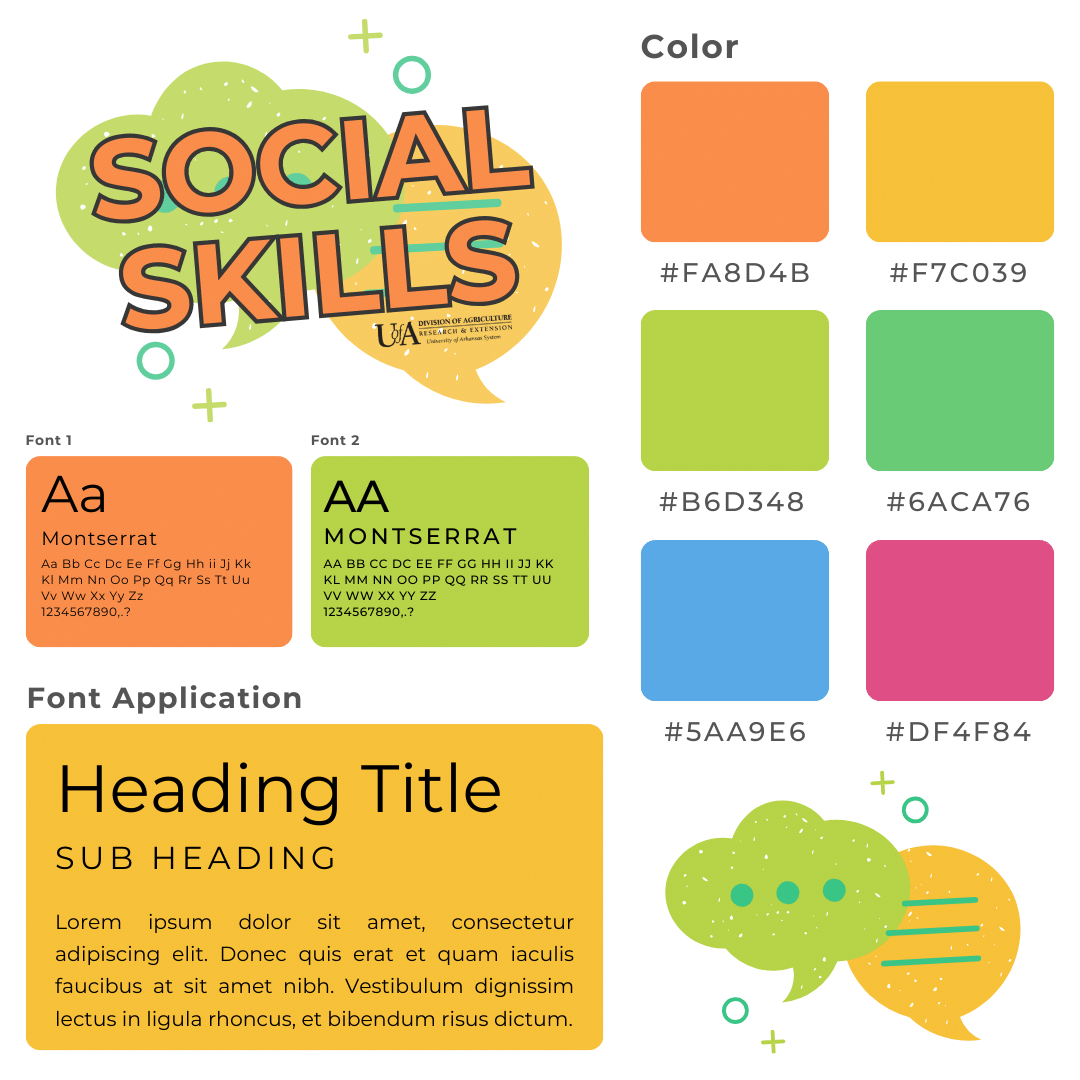
You can think about style and tone as the gift-wrap for your content. The suit and tie for your character.
Style and tone includes colors, fonts, the words you use, the way you write, the way you dress, the way you talk, the types of photos your take and share, the imagery you use, the kinds of videos you post and the types of content you share, and so much more.
Creating a Style
Your style will come in time as you get to know yourself, as you change and evolve, and as you get more practice working with your personal brand, style, and digital communication, but here are a few tips to consider while you are learning to work with your style and personal branding:
- Build a style that is authentic to your personality. Everything we are discussing here is all about authenticity. You want to ask yourself at every stop along your personal branding journey, "Does this feel authentic to me, my life, and my personality?"
- Don't get married to a style too early on. Especially in the beginning, but even seasoned stylists can completely change direction with their personal style. Sometimes when people choose a style, they can get locked into a color scheme or other stylistic choice and feel too stifled by it. Keep your style flexible and breathable.
- Get inspired with a mood board. Create a board on Pinterest or other tool that allows you to gather visual ideas all it one place (you could even do this in Canva or with magazines, glue, a poster board, and a pair or scissors!) and gather some elements that feel like YOU. Use this mood board as a jumping off point for developing your personal style.
- Make sure your style is accessible. Priortize readability and check that any colors you choose for your color scheme pass a readability test.
- Choose a style that is versatile, but give yourself some limitations. Give yourself plenty of room to play and get creative as you create content for your social media pages, but you will also want to narrow down your color scheme to no more than 10-ish colors and no more than 5-ish fonts. These are rough guidelines and are certainly not intended to stifle your creativity.
Developing Your Tone
Tone refers to the tone in which you speak and write as well as the language you are using. You can work on developing your tone for your personal brand. Below are a few things to note about tone:
- Know your audience: If you understand your audience, you will have a much clearer understanding of how best to communicate with them. Learn more about who you are talking to on social media, and you will be in a much better position to talk to them.
- Proofread: Make sure to give yourself a nice proofread before hitting publish so you can make sure you are saying exactly what you are trying to say.
- Be respectful, kind, and inclusive: Avoid bullying or talking down to people, and make an effort to be genuinely kind to people on the Internet.
- Develop empathy for people online: It is very easy to dehumanize people who are on the other side of a computer or phone screen from us, which is why bullying is so prevalent online. When you approach a situation with empathy, people will appreciate it.
- Make content digitally accessible: If you go the extra mile to make your content accessible, people will notice and thank you for it! Doing so shows you care and want to do your part in helping the Internet to be a more inclusive place for everyone.
- Give credit where credit is due: Always tag other accounts whose content you are sharing, and if there are ever times you need to download a photo or other type of content and reupload it the platform, you should ALWAYS ask permission, or at least give credit to the original creator.
Stop 4: Create & Curate Content
Content is the "meat and potatoes" of the Internet, and creating useful content that other people enjoy engaging with can be very helpful for your personal brand. Spend some time regularly creating and sharing content on your pages to have a healthy and active social media presence. Consider these things while you are creating and sharing content:
- Find your niche: You may already have a special topic or interest you like talking about, or you might like to talk about LOTS of stuff. Either way, it can sometimes be helpful in gathering a following if you are known for a certain topic. Find you angle and be the authority on your subject area!
- Share from reliable sources: Misinformation is rampant on social media, so if you are ever sharing something informative, make sure to fact-check it first! If you share info that is either misleading or incorrect, your page will not be taken seriously.
- Add your own spin on content you share: If you share content from other accounts, it can sometimes be seen as "lazy" or like you only ever share from other accounts and don't actually make your own content. If you do more sharing than creating, try to add your own perspective on what you are sharing.
- Tell your story: Everyone has a story to tell, and you can use social media to tell yours! There are infinitely many ways to tell stories, and you can your social media presence stand out if you allow others to go along your journey with you.
- Set some goals: It can be helpful when you are working with your personal brand to set some good goals. This might look like, "Get more followers," or "Make 1000 posts," or "Get really, really good at short-form videos."
- Search engine optimization: Optimize your content so it is more likely to be found in a search, assuming that is your goals. Search engine optimization (or, SEO) involves including commonly used keywords and hashtags that people are likely to use to find your content.
- Consider creating a content calendar: A content calendar can help with organization and to remember to post about important topics you had intended to post at certain times. Creating a list of topics you want to share and when that includes important dates and timely topics can be extremely helpful.
- Quality of quantity: Remember, the quality of your content is usually more important than how much content you are producing. There are times this statement is untrue, for example, in terms of "algorithm hacking," but it is easy to be perceived as "posting too much," which can also leave a bad taste in people's mouths regarding your content.
Content Ideas
If you are trying to come up with ideas for what you can post about, check out these content ideas for what you can share:
- Personal and professional achievements
- Community service and volunteering
- Seasonal content
- Memes
- Highlights from events you are attending
- Interactive content (e.g. polls)
- Travel experiences
- Recommendations (favorite books, movies, music, etc.)
- Fun trends
- Topics that interest you

Stop 5: Build Relationships
Your relationship and social media followers and connections are important for your personal brand. You will need to nurture your relationships, and while it is not always possible to respond to every message or comment, you can nurture your relationships in other ways:
- Be authentic: Being your authentic self helps to create good connections with others.
- Collaborate: If you are sharing content that involves other accounts on social media, be sure to tag their pages for better community online.
- Present at conferences: Presenting at conferences and other events helps you network and get your name out there, as well as gives you the opportunity to promote your social media pages and personal brand.
- Show your appreciation for your followers: If you hit milestones or have a piece of content that goes viral and gets a lot of new followers, give a shoutout and a thank you to your followers.
- Follow up with people: If you tell people you are are going to do something or help them in some way, follow-up and follow through. This will help you create stronger bonds with people.
- Share helpful resources: Create and share helpful resources with your audience that is useful to them.
- Be personal, but not too personal: Find the balance between being personal enough to create a connection with your audience, but not so personal that you are "airing your dirty laundry," so to speak.
- Share others' content: When you share other's content, it gives their pages a boost, so remember, sharing is caring!

Stop 6: Improve Your Skills
As you get more experience working with your personal brand and social media, you will naturally develop your skills. But, if you want to enhance your skills to be a social media superstar, here are some skills I recommend sharpening:
- Writing
- Proofreading
- Basic video skills
- Basic graphic design skills
- Photography
- Basic web design
- Cybersecurity
- Journaling and self-reflection
- Storytelling
- Marketing
- Search engine optimization
- Digital accessibility
- Public speaking
- Organization

Stop 7: Seek Feedback
Once you have established your personal brand a bit, you may wish to seek some feedback. There are several ways to get feedback on your digital presence and your personal brand, some of which include:
- Asking a mentor what they think.
- Putting a poll out on social media.
- Looking at your social media analytics and your content's performance.
- Ask a peer to take a look.
- Ask your audience their thoughts.
- Request testimonials from your biggest fans.
- Find online communities that focus on giving feedback to each other.
Stop 8: Consistency & Maintenance
Finally, our last stop is consistency and maintenance, quite possibly the most challenging part of this entire process.
Below are some tips being consistent and maintaining your personal brand:
- Know your goals and revisit regularly:
- Try to post on social media consistently: Find a posting schedule that works for you and stick with it.
- Ask yourself, "Is what you are doing working for you?"
- Keep learning new skills and improving!
- Adapt your goals as your needs change.
- Check up on your contact info and make updates as needed.
- Look at your analytics
- Engage with your audience regularly
- Stick to your style, but allow it to evolve with you
- Regularly update your profile pic and cover photo
How Often Should I Revisit This Roadmap?
You will want to revisit this roadmap to take a look at your personal brand and make updates as needed. You can assess your personal brand as frequently as you'd like, but I would recommend revisiting about once a year or so.
If you have questions about crafting your personal brand, please reach out to socialmedia@uada.edu!